Join your dream strategy consulting firm or internal strategy team, with a system built around how each firm and market hires
For experienced professionals two to ten years into their careers, and MBA students.





30+ mentees working in strategy across 10+ countries in Europe, the Middle East, Asia and the Americas in companies such as










Six common reasons good candidates do not land a strategy role
Most candidates do at least one of these somewhere in their preparation.
-
You put your effort into only one part of the process. Mock case interviews feel productive, so the CV and the networking wait, or vice versa. The part you skip is what rejects you.
-
You position yourself identically with every company in every region. McKinsey London, a tier-two firm in Dubai and a corporate strategy team in Hong Kong are not hiring the same person.
-
You picked a mentor for their ex-MBB credentials. They can score your interview, but they stopped preparing for these cases years ago and cannot drill with you or tell you how to do the same.
-
You collect more casebooks, online resources and YouTube videos than you can get through. Failing to plan is planning to fail.
-
You have done thirty cases and repeated the same mistake in all of them. Practice without correction rehearses the flaw.
-
You take advice from too many people. No two of them agree and none of them are tracking your progress.
We build our mentorship for your unique situation
No two candidates start in the same place, so no two plans look alike. The pace, the session count and the order of sessions are built around where you are. Three we have run:
Career switch from a non-strategy role
Seven sessions over ten weeks. The CV and the outreach come first, with case practice starting in week five.
Recruiter call landed, first round in two weeks
Six sessions over two weeks. Market sizing, structuring and graph reading, then two mock interviews.
Four classmates, one recruiting season
Eight sessions over nine weeks. One shared plan, everyone cases in the room, at a lower cost each.
*Illustrative plans, not individual case studies. Yours is built with you.
Our success stories speak for themselves
Hear from candidates who worked with our founder, Rishikesh
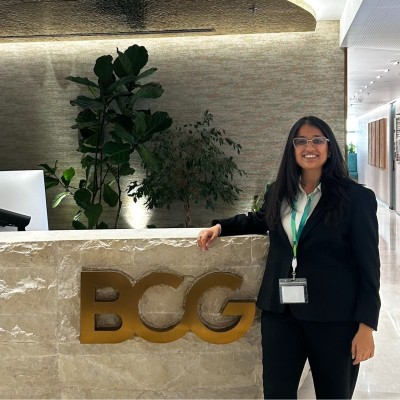


These are real mentees, and results vary. Some get offers, some do not. Where you start, the market you are recruiting in, the timing of your applications and the work you put in between sessions all decide that. Nothing here is a guarantee. Mentorship makes your preparation better, it does not promise you an offer.
Four steps to your first session
The first three steps are how we work out whether we are a good fit for your situation. No financial commitment until after step three. Sessions start at USD 169.
Browse
Look through the sessions and the two formats, so you know what is on offer before you apply.
Apply
Where you are, what you are targeting, and a rough idea of the sessions you want to start with. Two minutes.
Introductory Call
Free, and thirty minutes. We clear up anything from your application, then agree on the sequence and a tentative session count together.
Start
Your case partner runs every session from there, and the plan changes as you move.
Meet the founder, and your mentor

Hi, I am Rishikesh. If you are on this page, you are choosing who to trust with your recruiting season, and I would like that to be me.
I run Kularion, a boutique consulting firm in Dubai, after eight years in consulting across Europe, Africa, Asia and South America, the last stint of it at Kearney in this city. Getting here was not a straight line. I entered the industry three separate times, once as an undergraduate, once as a lateral hire, once after an MBA, and each of those doors has its own screen. I have also sat on the hiring side at two firms, running the interviews myself, which is where you learn how narrow the margin usually is.
The market in 2026 is fundamentally different. Smaller classes, longer processes, more strong applicants per seat than at any point in my career, and the firms met that by raising the bar rather than lowering it. Preparing the old way does not clear it anymore - a few frameworks from a YouTube video, a casebook from some MBA, five people giving you five inputs and none of them watching you twice.
ANVIL is what I built instead. I run every session myself and take a small number of candidates each year, because the value here is that the person across from you in session six remembers session two. Position first, then the story, then the interview mechanics, drilled in sequence against one standard and kept current through standing conversations with recruiters and hiring managers inside the firms.
If you are capable, willing to put in the work, and serious about a seat in strategy, I built this for you.
Rishikesh Kulkarni (RK)
Questions people ask before booking
I already have CaseCoach. Do I need this as well?
They solve different halves of the problem. CaseCoach is a library: good material, worked examples, a consistent standard written down. I use it as a reference inside sessions, so if you already have it, it keeps earning its place.
What a library cannot do is watch you. It cannot tell you that you spend the first ninety seconds of every case narrating instead of structuring, that your synthesis falls apart the moment the numbers turn ugly, or that the way you explain leaving your last role is the thing quietly costing you offers. Those are patterns, and a pattern only shows up to somebody who has seen you more than once. Keep the content. Add the coaching.
How is this different from casing with peers or an alum who offered to help?
Free help is real help and you should take it. It is also one-off, squeezed between somebody else’s priorities, and blind to everything that happened in your last session. Peers tend to reproduce each other’s blind spots, because you are all learning the same wrong things at the same speed.
The missing piece is calibration. Somebody has to know where the bar actually sits this cycle and hold you to it every week, rather than telling you that was pretty good.
What happens in the introductory call?
The introductory call is free, thirty minutes, and comes after your application. It is a diagnostic rather than a sales conversation: which route you are entering by, your timeline, the firms you are targeting, and where you think you are weakest.
I tell you what I would work on first and in what order, and we agree a tentative session count. Sequence is most of the value, so this is where it gets decided. Nothing is payable until after that call, and your first paid session starts on what we identified rather than on a standard curriculum.
How many sessions do people usually take?
Most plans run between five and ten, booked one at a time or as a bundle. Someone with a clean profile eight weeks from interviews needs fewer than someone rebuilding their positioning from the ground up. I tell you what I think you need on the introductory call, and you decide from there.
When should I start?
Earlier than most people do. Positioning, story and networking move slowly and compound over months. Case mechanics sharpen in weeks. If applications are eight to twelve weeks out, this is the right window.
If your interview is next Tuesday, we work on what can still change by then, and I will tell you plainly what cannot.
How do I know whether my university has an arrangement with you?
The booking questions ask which university or programme you are at. If there is an arrangement in place with your school, your consulting club or your careers service, I will see it when I read your answers, and we cover what it means for you on the introductory call.
If there is no arrangement yet, say so anyway. Most of them started with one candidate asking.
My background is not traditional. Is this for me?
Very likely. Non-target school, career switcher, industry hire, second attempt after a ding: none of that is disqualifying on its own. I entered consulting three times by three different routes, and each of them required a different story to be credible.
The question a firm is actually asking is not whether your path is unusual. It is whether the path reads as deliberate and whether you can think under pressure. Both of those are workable.
Do you only work on cases?
No. Cases are the visible part of recruiting and the smallest part of why people get rejected. Sessions cover positioning and firm selection, the CV and LinkedIn, networking that gets replies, fit and behavioural, and case skill building. You can take any of them on their own or run the full sequence.
Should I do 1-on-1 or the group program?
1-on-1 is preparing on your own with me. The group program is for people who already have, or can put together, a group of up to four: friends from your program, colleagues, anyone else preparing at the same time. You book sessions as one group, which brings the cost per person down and gives you people to drill with between sessions.
Neither choice locks you in. Groups regularly take individual sessions for the parts that are personal, a CV review or a mock before a specific interview, and people who start alone sometimes bring a group together later.
Can you guarantee an offer?
No, and I would be careful with anyone who does. Firms decide, and the market, your timing and a certain amount of luck all sit outside this room.
What preparation does is remove the failures that are predictable: the unstructured opening, the story that raises a question you cannot answer, the arithmetic that falls apart under pressure. It makes the interview a test of your thinking rather than a test of things nobody told you were being scored.
Ready to start preparing with structure?
Every session is a full hour with the same mentor. Most plans run between five and ten sessions, booked one at a time or as a bundle.
*Some universities have a discount arrangement with us. If yours does, claim it in the application form.